Showing posts with label horror. Show all posts
Dreams are mostly fascinating, exciting, terrifying, Mysterious, bewildering, eye-opening and sometimes a nightmarish living hell or just plain weird. dreams are all that and much more.Here are 10 amazing facts about dreams that you might have never heard about.
10. Not everyone dreams in color
While approximately 80 percent of all dreams are in color, there are a small percentage of people who claim to only dream in black and white.As much as 12% of people only dream in black and white.
9. Blind people dream too
Blind people who were not born blind see images in their dreams but people who were born blind don’t see anything at all. They still dream, and their dreams are just as intense and interesting, but they involve the other senses beside sight.
8. You can linger in a dream after waking.
Have you ever woken up from such a beautiful, perfect dream that you wished you could go back to sleep to soak it all up (you know, the dream about George Clooney?)? You can! Just lie still—don’t move a muscle—and you can remain in a semi-dreamlike state for a few minutes. “The best way to remember your dreams is to simply stay put when you wake up,” says Loewenberg. “Remain in the position you woke up in, because that is the position you were dreaming in. When you move your body, you disconnect yourself from the dream you were just in seconds ago.”
7. You Forget Most of Your Dreams
95 percent of all dreams are quickly forgotten shortly after waking.You can have up to seven different dreams per night depending on how many REM (Rapid Eye Moment) cycles you have. We only dream during the REM period of sleep, and the average person dreams one to two hours every night.
6. Dreams tend to be negative
Surprisingly, dreams are more often negative than positive. The three most widely reported emotions felt during dreaming are anger, sadness and fear.
5. You can’t tell time or Read while Dreaming
If you are unsure whether you are dreaming or not, try reading something. The vast majority of people are incapable of reading in their dreams. The same goes for clocks: each time you look at a clock it will tell a different time and the hands on the clock won’t appear to be moving as reported by lucid dreamers.
4. You Can Control Your Dreams
There is a whole subculture of people practicing what is called lucid or conscious dreaming. Using various techniques, these people have supposedly learned to assume control of their dreams and do amazing things like flying, passing through walls, and traveling to different dimensions or even back in time.
3. In our dreams we only see faces that we already know
The human brain is responsible for many complex creations, but it can’t invent the image of people. So the “strangers” that you meet in your dreams actually have the faces of people who you’ve once seen in your real life but forgotten, like your childhood mailman or that guy bumped into on the side walk that one time.
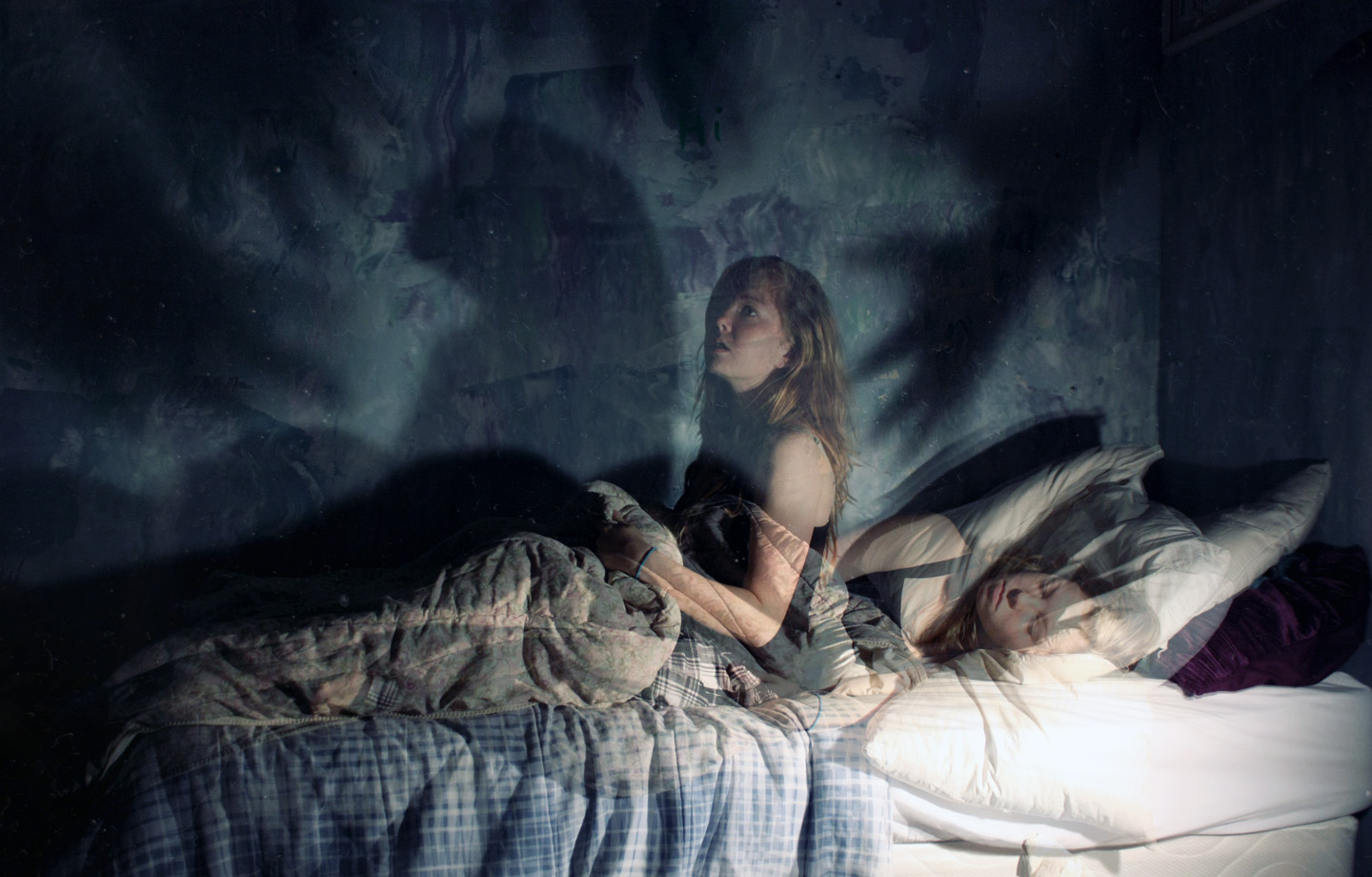 2. Sleep paralysis
Two characteristics of sleep paralysis are the inability to move (hence paralysis) and a sense of an extremely evil presence in the room with you. It doesn't feel like a dream, but 100% real. IT amplify the emotions of fear, terror and anxiety.
Enough Said!!!
1. Dream drug
There are actually people who like dreaming and dreams so much that they never want to wake up. They want to continue on dreaming even during the day, so they take an illegal and extremely potent hallucinogenic drug called Dimethyltryptamine. It is actually only an isolated and synthetic form of the chemical our brains produce naturally during dreaming.
A ghost ( phantom, apparition or spook) is the soul or spirit of a dead person or animal that can appear, in visible form or other manifestation, to the living. Descriptions of the apparition of ghosts vary widely from an invisible presence to translucent or barely visible wispy shapes, to realistic, lifelike visions.
 Although the human soul was sometimes symbolically or literally depicted in ancient cultures as a bird or other animal, it appears to have been widely held that the soul was an exact reproduction of the body in every feature, even down to clothing the person wore. This is depicted in artwork from various ancient cultures, including such works as the Egyptian Book of the Dead, which shows deceased people in the afterlife appearing much as they did before death, including the style of dress.
Ghosts and the afterlife
Fear of ghosts
While deceased ancestors are universally regarded as venerable, and often imagined as having a continued presence in some sort of afterlife, the spirit of a deceased person which remains present in the material world (viz. a ghost) is regarded as an unnatural or undesirable state of affairs and the idea of ghosts orrevenants is associated with a reaction of fear. This is universally the case in pre-modern folk cultures, but fear of ghosts also remains an integral aspect of the modern ghost story, Gothic horror, and other horror fiction dealing with the supernatural.
History
There are many references to ghosts in Mesopotamian religions – the religions of Sumer, Babylon, Assyria and other early states in Mesopotamia. Traces of these beliefs survive in the laterAbrahamic religions that came to dominate the region.[26] Ghosts were thought to be created at time of death, taking on the memory and personality of the dead person. They traveled to the netherworld, where they were assigned a position, and led an existence similar in some ways to that of the living. Relatives of the dead were expected to make offerings of food and drink to the dead to ease their conditions. If they did not, the ghosts could inflict misfortune and illness on the living. Traditional healing practices ascribed a variety of illnesses to the action of ghosts, while others were caused by gods or demons.
The ancient Romans believed a ghost could be used to exact revenge on an enemy by scratching a curse on a piece of lead or pottery and placing it into a grave.
Ghosts reported in medieval Europe tended to fall into two categories: the souls of the dead, or demons. The souls of the dead returned for a specific purpose. Demonic ghosts were those which existed only to torment or tempt the living. The living could tell them apart by demanding their purpose in the name of Jesus Christ. The soul of a dead person would divulge their mission, while a demonic ghost would be banished at the sound of the Holy Name.
There was widespread belief in ghosts in ancient Egyptian culture in the sense of the continued existence of the soul and spirit after death, with the ability to assist or harm the living, and the possibility of a second death. Over a period of more than 2,500 years, Egyptian beliefs about the nature of the afterlife evolved constantly. Many of these beliefs were recorded in inscriptions, papyrus scrolls and tomb paintings. The Egyptian Book of the Dead compiles some of the beliefs from different periods of ancient Egyptian history.[28] In modern times, the fanciful concept of a mummy coming back to life and wreaking vengeance when disturbed has spawned a whole genre of horror stories and films.
Sceintific views
The physician John Ferriar wrote An essay towards a theory of apparitions in 1813 in which he argued that sightings of ghosts were the result of optical illusions. Later the French physician Alexandre Jacques François Brière de Boismont published On Hallucinations: Or, the Rational History of Apparitions, Dreams, Ecstasy, Magnetism, and Somnambulism in 1845 in which he claimed sightings of ghosts were the result of hallucinations.
Joe Nickell of the Committee for Skeptical Inquiry, wrote that there was no credible scientific evidence that any location was inhabited by spirits of the dead. Limitations of human perceptionand ordinary physical explanations can account for ghost sightings; for example, air pressure changes in a home causing doors to slam, or lights from a passing car reflected through a window at night. Pareidolia, an innate tendency to recognize patterns in random perceptions, is what some skeptics believe causes people to believe that they have 'seen ghosts'. Reports of ghosts "seen out of the corner of the eye" may be accounted for by the sensitivity of human peripheral vision. According to Nickell, peripheral vision can easily mislead, especially late at night when the brain is tired and more likely to misinterpret sights and sounds."
According to research in anomalistic psychology visions of ghosts may arise from hypnagogic hallucinations ("waking dreams" which are experienced in the transitional states to and fromsleep). In a study of two experiments into alleged hauntings (Wiseman et al. 2003) came to the conclusion "that people consistently report unusual experiences in ‘haunted’ areas because of environmental factors, which may differ across locations." Some of these factors included "the variance of local magnetic Žfields, size of location and lighting level stimuli of which witnesses may not be consciously aware"
Some researchers, such as Michael Persinger of Laurentian University, Canada, have speculated that changes in geomagnetic fields (created, e.g., by tectonic stresses in the Earth's crust orsolar activity) could stimulate the brain's temporal lobes and produce many of the experiences associated with hauntings. Sound is thought to be another cause of supposed sightings. Richard Lord and Richard Wiseman have concluded that infrasound can cause humans to experience bizarre feelings in a room, such as anxiety, extreme sorrow, a feeling of being watched, or even the chills. Carbon monoxide poisoning, which can cause changes in perception of the visual and auditory systems, was speculated upon as a possible explanation for haunted houses as early as 1921.


